
“There must have been important people on that plane,” a TV commentator said after the first plane hit one of the World Trade Center twin towers in New York on Sept. 11, 2001.
I know exactly what he meant. But when we think about it, all the passengers were important in God’s eyes.
Each was a child of God, created in God’s image and likeness.
Each was someone’s husband, wife, child, mother, brother, sister, grandmother or grandfather.
In the eyes of our culture and much of the world, the important people are celebrities, movie stars, professional or college athletes, business executives, politicians or people with money, fame and beauty.
The clothes we wear, the neighborhood we live in, the car we drive are often used as indicators of how important we are in society.
Some children are ashamed to wear clothes with no brand names on them.
“What do you do for a living?” This is often the question people ask at gatherings when they do not know one another.
It sounds offensive when a commentator says “The uneducated white males did not vote for candidate so-and- so.”
Even a little cross on a lapel can elevate one to a higher status in someone’s mind. It happened to me once in a tour of the catacombs near Rome.
I did not know at that time that if some people see someone wearing a cross on his lapel, they assume he is a priest. Because I was wearing one, I was considered an important person and was given the privilege of sitting in the front row.
Apparently, to be regarded as important was also important to the Apostles.
Jesus at one point told the Apostles that He was going to suffer and die and they immediately began arguing among themselves about who would be most important in the Kingdom of God. (Luke 9:46ff).
I wonder if they really heard what Jesus was telling them about His impending passion.
The fact that there was an acknowledgment that the Apostles were arguing could be seen as proof of the reliability of the Gospels.
If the Gospels were fiction, the Apostles would have made themselves look brilliant and courageous. Instead, they look like idiots.
Jesus used this incident to teach the Apostles and us what true greatness is.
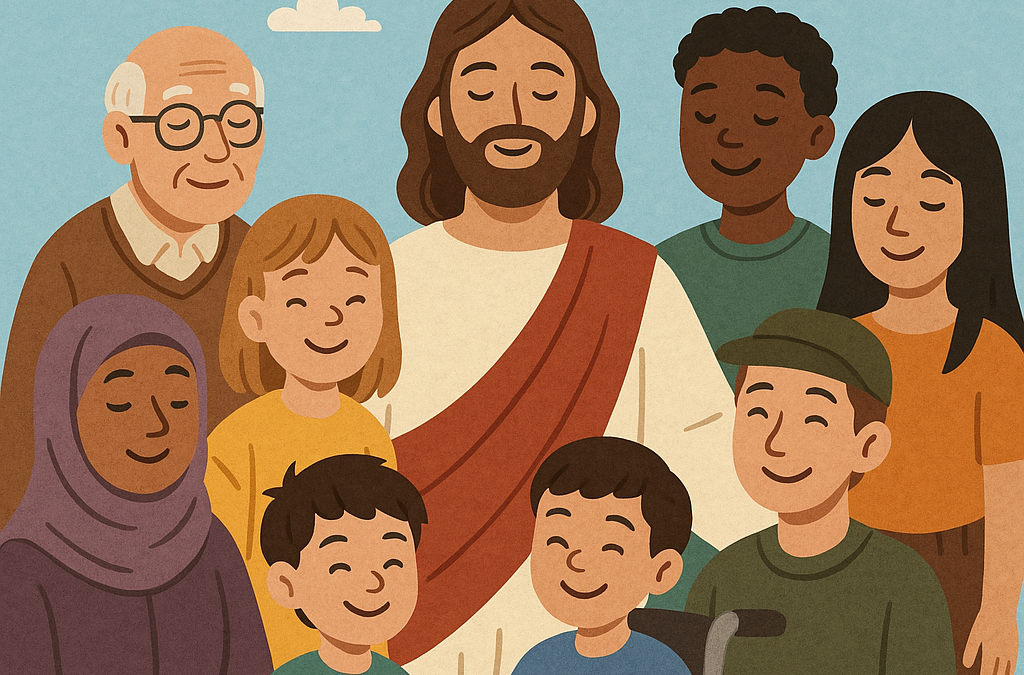
He did this, by using a child. He called the child to Himself and put his arms around the child to show how much He valued the child.
To grasp what Jesus did, it is important to understand that in the ancient world, children were not symbols of cuteness and innocence.
In Jesus’ time, children were considered “non-persons”.
Because they were totally dependent on others, they had no rights and no status.
To be kind to a child or to welcome a child as Jesus did
was not a virtuous act. It was an act that would bring no reward.
But in Jesus’ eyes, no person was more important or less important than another.
There is no income bracket or title or celebrity that can make one inferior or superior to another.
In Jesus eyes, we are all equal in dignity. We are not the same, but we are equal.
We all have the same origin. We all have the same destiny. We all have the same Father – God.
“Outside the Blessed Sacrament, our neighbor is the holiest object that we could ever be in contact with,” C.S. Lewis once wrote.
Every neighbor – including a family member who no longer goes to church, a child in school who “does not fit,” a woman in line at a soup kitchen waiting for something to eat, or an unborn baby in a mother’s womb.
To make Christ’s teaching concrete and practical, let us think of one person in our life with whom we struggle – one who annoys us to no end or who grates on our nerves or one who seems to have no hope.
We can sincerely ask God for the grace to recognize that person’s worth, dignity and importance – for all are important in God’s eyes – and act accordingly.
We need to ask God to do it without smugness. We need grace to ponder this humbling thought – that the annoying person with whom we struggle, the one who grates on our nerves, the one who annoys us to no end, may be me.