
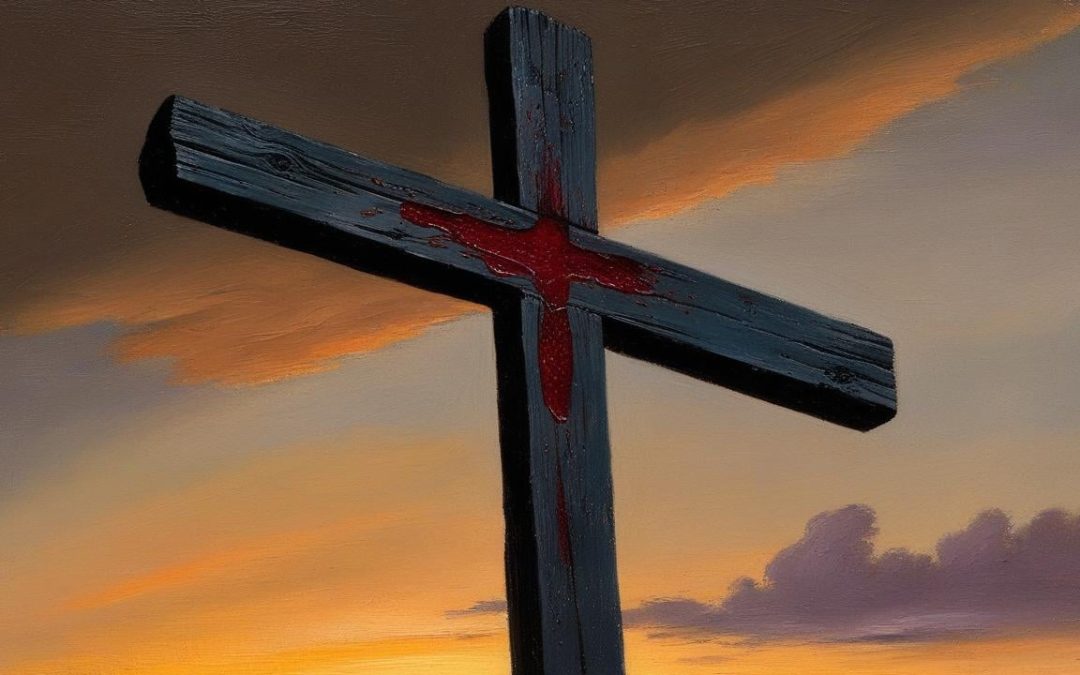
Have you been to Jesus for the cleansing power?
Are you washed in the blood of the Lamb?
Are you fully trusting in His grace this hour?
Are you washed in the blood of the Lamb?
Are you washed in the blood?
In the soul cleansing blood of the Lamb?
Are your garments spotless, are they white as snow?
Are you washed in the blood of the Lamb?
Are you walking daily by the Savior’s side?
Are you washed in the blood of the Lamb?
Do you rest each moment in the crucified?
Are you washed in the blood of the Lamb?
Are your garments spotless, are they white as snow?
Are you washed in the blood of the Lamb?
Song by Randy Travis ‧ 2005
Have you heard this song? Do you like it?
We learn from Scripture that there is a connection between
blood and mercy.
After the Crucifixion, a soldier stuck his spear into Jesus’ side and at once, blood and water came out. (John 19:34).
From Adam’s generation forward, it was believed that without the shedding of blood, there was no forgiveness. (Hebrews 9:22).
Somehow, Abel knew that to offer God prayers and harvest from the fields was not enough.
Somehow, Abel knew that a sacrifice of life was required, that to pour out his heart was not enough, that blood must be poured out.
So with the ground as his altar, Abel was the first to offer blood sacrifice for sins.
Abel’s action was followed by the generations that came after him, until the final sacrifice of Christ on the cross at Calvary.
Those who imitated Abel formed a long line – Abraham, Moses, Gideon, Samuel, David, to name a few.
Somehow they too, knew that the offering of blood is necessary for the forgiveness of sins.
But the offering of blood sacrifice ended on the cross at Calvary on Good Friday.
What Abel achieved in the field, Christ achieved on the cross. What Abel began, Christ completed.
After Christ’s sacrifice, there would be no more blood sacrificial system because Christ came as high priest of a better system, which we now have – the Holy Sacrifice of the Mass.
After Christ’s sacrifice on the cross, there would be no more need to shed blood.
Christ, once for all, took blood into the inner room – the Holy of Holies – and sprinkled it at the mercy seat.
But what Christ sprinkled was not the blood of goats and calves.
Christ took his own blood and with it, He made sure of our eternal salvation. (Hebrews 9:12).
At the final blood sacrifice on Good Friday, Christ was both the high priest and the sacrificial lamb.
Earlier in Jesus’ life, John the Baptist at Jordan proclaimed that Jesus was the “Lamb of God that takes away the sins of the world.”
At Calvary, John’s proclamation was actualized: the Son of God became the Lamb of God.
The cross became an altar. And we were made holy through Christ’s sacrifice in his body once and for all. (Hebrews 10:10).
Christ’s blood does not cover our sins. It does not cancel our sins. It does not postpone our sins. It does not diminish our sins.
Jesus’ blood takes away our sins. Jesus allows our sins to be lost in his perfection.
In heaven, only God will know our sins. But we will not be embarrassed because Jesus has already forgiven them.
In Calvary, what had to be paid was paid. What had to be done was done.
Innocent blood was required and innocent blood was offered, once for all and for all time.
The water that came out from the side of Jesus is grace. The water is the Holy Spirit.
Earlier in Jesus’ life, at a well in Samaria, Christ told the woman who came at noon to fetch water that the water He was going to give her would become a spring gushing inside her, giving her eternal life. (John 4:14).
Jesus offers not a singular drink of water. What He offers is an artesian well – not a hole in a backyard, but the Holy Spirit in our hearts.
The Holy Spirit does not save us. Christ has accomplished our salvation on the cross.
The work of the Holy Spirit in us is sanctification.
The work of the Holy Spirit is to change us – to make us holy.
Paul explains the changing or the sanctifying process in this way: “Do good things, as a result from being saved, obeying God with great reverence, shrinking back from all that might displease God, for God is at work in you, helping you to obey God, and then helping you to do what God wants you to do” (Philippians 2:12-13).
“O Blood and Water, which gushed forth from the Heart of Jesus as a fount of Mercy for us, I trust in You” is a line from the Divine Mercy prayer. The prayer is a way to reflect on the mercy of God and to ask for God’s forgiveness.